
Views: 0 Author: Site Editor Publish Time: 2026-05-19 Origin: Site


Hanging an Outdoor Light transforms your exterior space from dark and uninviting to safe and welcoming. However, this task presents unique challenges compared to standard indoor electrical work. Weather exposure, varied exterior siding materials, and strict electrical code requirements add significant layers of complexity. A poor installation risks severe water intrusion into your home walls. It can also cause permanent siding damage or trigger a dangerous electrical fire.
This guide divides the installation process into two distinct project paths. First, you will learn how to hardwire permanent exterior fixtures like sconces or floodlights. Second, we will show you how to safely suspend ambient patio string lights across large open spaces. We aim to equip you with essential evaluation criteria. You will know exactly whether you can complete the project yourself. You will also understand what specialized hardware your specific exterior requires and how to execute the entire job safely up to code.
Electrical Safety: Hardwired fixtures require circuit breaker disconnection and exact wiring alignment (black-to-black, white-to-white, ground-to-screw).
Weatherproofing: Never seal the bottom of an outdoor fixture; caulk only the top half to allow condensation drainage.
Siding Adaptability: Vinyl, stucco, and fiber cement require specific mounting blocks or masonry anchors—never drill directly without assessing the material.
String Light Infrastructure: Suspending string lights over long spans requires tension-relieving guy wires and GFCI-protected outlets, not just standard hooks.
Before you purchase tools or fixtures, you must establish a clear decision framework. Evaluating your current electrical infrastructure helps you determine the project scope. It also clarifies whether you need a professional.
Replacing an existing wall sconce or floodlight involves low complexity. The foundational work already exists. You primarily need to verify the existing junction box. Check if it remains securely anchored to the structural wood behind the siding. Ensure the box is entirely weatherproof and free from deep rust. If the box feels loose, you must secure it before proceeding. You can handle this task with basic hand tools and a voltage tester.
Installing a brand-new fixture where no outlet box exists presents high complexity. You must pull new NM cable (Romex) through your wall cavities. You also need to cut a precise hole into your exterior siding. We recommend a cautious implementation reality here. Avoid drilling an oversized 4-inch hole directly into your siding. A large hole severely weakens the surrounding material. Instead, use a dedicated siding block. Alternatively, install a 3.5-inch pancake box paired with a precise 3 5/8-inch hole saw. This creates a tight, code-compliant fit without compromising structural integrity.
Your exterior wall material dictates your hardware choices entirely. You cannot treat vinyl the same way you treat solid brick. Below is a detailed chart outlining the required hardware for various exterior surfaces.
Siding Material | Required Hardware & Tools | Installation Rules |
|---|---|---|
Vinyl / Fiber Cement | Specialized siding mounting block, standard drill, sealant. | Requires a mounting block to create a flat, gap-free surface. Never screw tightly over lapped vinyl directly. |
Brick / Stone | Hammer drill, masonry bits, concrete wall anchors. | You must use a masonry bit. Anchor screws directly into the mortar joints or solid brick to prevent crumbling. |
Stucco | Specialized stucco wall anchors, heavy-duty back plates. | Distribute the weight of heavier fixtures using back plates. Use anchors rated for crumbling materials. |
Once you verify your materials and secure the correct junction box, you can begin the installation. Follow these exact steps to ensure structural safety and electrical compliance.
Locate your main electrical panel and turn off the specific breaker supplying power to the outdoor circuit.
Verify the power is completely off using a reliable non-contact voltage tester.
Unscrew the old fixture from the wall bracket carefully.
Disconnect the old wires by untwisting the wire nuts.
You must practice strict risk mitigation during this step. When removing the old fixture, do not pull too hard. More importantly, avoid pushing bare wires back into the wall cavity. They easily fall out of reach and become extremely difficult to retrieve later.
Your junction box must sit perfectly flush with the exterior surface. It should anchor securely into the structural wood beneath the siding. It must never just float loosely in the siding material. If you remove an old bracket, you might see exposed pilot holes. Use exterior-grade wood putty or specialized siding sealant to fill these exposed holes immediately. This prevents moisture from seeping behind your walls.
Proper electrical wiring requires focus and exact color-matching. Begin by attaching your ground wire. This wire is usually bare copper or green insulation. Wrap it securely around the green grounding screw located on the new mounting bracket. Tighten the screw firmly.
Next, connect the neutral wires together. You will match the white wire from the house to the white wire on the fixture. After that, connect the hot wires. Match the black wire from the house to the black wire on the fixture. You must verify every connection. Ensure all wire ends twist clockwise together. Cap them tightly using appropriately sized wire nuts. Give each nut a gentle tug to confirm the wires will not slip out.
Tuck all wires neatly into the junction box. Make sure no wires get pinched behind the metal bracket. Secure the fixture housing onto the mounting bracket using the provided decorative nuts or screws. Before tightening them completely, check the fixture for proper level alignment using a small torpedo level. Once aligned, tighten the screws down. Install the recommended light bulb. Finally, restore power at the circuit breaker and flip the wall switch to test your new installation.
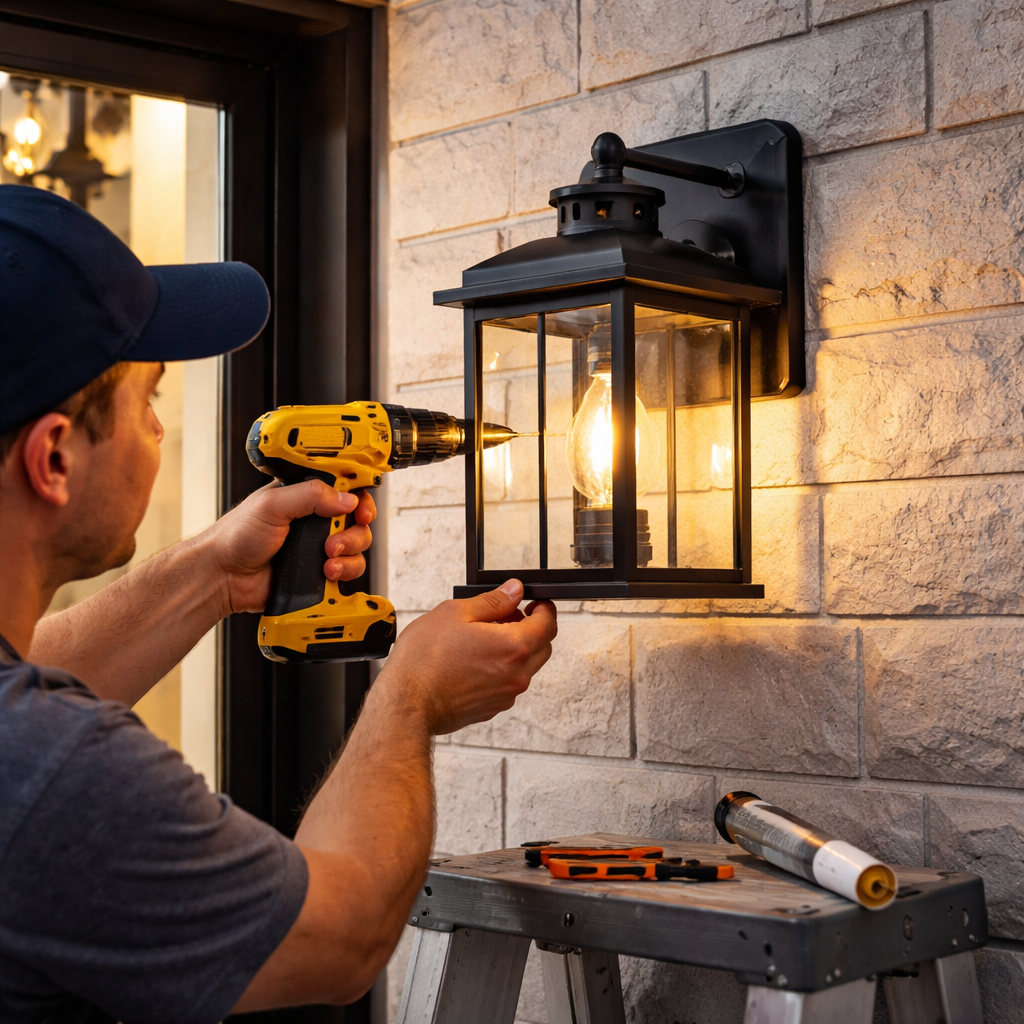
Many homeowners attempt electrical DIY projects without fully understanding safety regulations. Professional electricians frequently highlight dangerous errors found in residential exterior lighting. We address the most critical violations below to protect your home.
Many novices run bare wires directly through the sharp metal knockout holes of a junction box. This creates a severe fire hazard. The sharp edges easily slice through the wire insulation over time. You must use a metal or plastic Romex connector. This connector acts as strain relief. It locks the cable in place and prevents dangerous wire chafing.
Junction boxes feature several circular knockouts for wire entry. Sometimes people punch out too many holes and leave them open. The junction box must remain fully sealed to meet safety codes. Unused knockout holes allow moisture to enter. More dangerously, they fail to contain potential electrical sparks. You must plug any unused holes using specialized metal knockout seals.
Homeowners often try to aggressively waterproof their fixtures by caulking the entire base. This creates a disastrous water trap. You should always follow the "top-seal, bottom-drain" rule. Apply exterior-grade silicone caulk only along the top half and the sides of the fixture base. Leave the bottom unsealed completely. This opening allows trapped internal condensation to safely escape.
When you pull NM cable into the junction box, you must pay attention to the outer plastic sheathing. Stripping it too far back leaves bare inner wires exposed outside the box. Electrical code dictates a strict measurement. The outer Romex cable sheathing must extend at least 1/4-inch into the junction box itself.
Screwing a fixture mounting plate directly over lapped vinyl siding causes major issues. The pressure crushes the delicate vinyl. It also creates large, unsealable gaps behind the fixture base. Water easily blows into these gaps during rainstorms. You must cut the vinyl siding back carefully. Install a proper surface block that fits the siding profile perfectly.
Hanging ambient string lights requires entirely different techniques compared to wall-mounted fixtures. You deal with long wire spans, wind loads, and unique support structures.
Choosing the right hardware prevents your lights from falling during heavy winds. Review these hardware guidelines before beginning your project.
Recommended: We strongly advise using stainless steel screw hooks. Cup hooks paired with carabiner clips also work exceptionally well. They secure the wires firmly while allowing easy removal.
Avoid: Never use standard iron nails. They will rust quickly and leave permanent dark stains on your siding. Stay away from picture hooks. They simply cannot withstand outdoor wind loads.
Suspending string lights across an open patio without a support cable guarantees failure. Long spans of heavy commercial-grade light cords experience extreme tension. Over time, the internal copper wires suffer fatigue and snap. You must install a steel guy wire first. Pull this support cable taut between your mounting points. Afterward, attach your string lights directly to the guy wire using outdoor UV-rated zip ties. This method transfers all mechanical stress onto the steel cable rather than the fragile electrical cord.
Proper planning prevents you from running out of lights halfway through the project. Always measure your linear distance first. Then, apply a simple spacing formula. Add 2 to 6 feet of extra length to your total measurement. This additional length accounts for the natural sag, also known as the swag, between connection points.
Consider these classic layout models for your space:
V-Pattern: You anchor the lights to a single apex point on your roof and fan them outward.
X-Pattern: This works beautifully for square courtyard spaces, crisscrossing the strings in the center.
Zig-Zag: Use this pattern to achieve maximum area coverage across a wide, open deck.
Safety remains paramount even with plug-in lighting. You must plug string lights into a GFCI-protected outdoor receptacle. GFCI outlets automatically cut power if moisture breaches the plug. Furthermore, read the tag near the plug of your lights. Never exceed the manufacturer’s "maximum connected strands" limit. Stringing too many sets together overloads the internal fuses and melts the wires.
Not everyone can drill holes into exterior walls. Many audiences face strict landlord rules. Others simply remain unwilling to breach their home's protective moisture barrier. For these individuals, alternative hanging methods exist.
You can successfully mount lighting by utilizing heavy-duty, outdoor-rated mounting tape. Products like Gorilla Tough & Clear mounting tape offer incredible adhesion properties. You apply strips to the back of a flat mounting plate. Press it firmly against a clean, dry exterior wall for 60 seconds. This creates a strong bond without causing structural damage.
While effective, this system carries strict limitations. You cannot use tape for heavy glass sconces or hardwired electrical boxes.
Weight Limits: This method is exclusively suitable for lightweight, solar-powered motion lights. The fixture should weigh 2-3 lbs maximum. Solar units also eliminate the need for wiring entirely.
Surface Compatibility: Tape works excellently on flat metal, treated wood, and smooth brick. However, it fails completely on porous vinyl fencing. It also peels away easily from crumbling stucco due to poor surface contact.
Hanging an exterior light successfully balances beautiful aesthetic goals with strict environmental realities. You must respect electrical codes and weatherproofing standards equally. We advise you to map your circuit breaker properly before starting any work. Purchase the correct siding-specific mounting blocks for your wall type. Always draw a clear layout plan before buying fixtures or string lights.
Finally, recognize your own limitations. If your home has no existing outdoor wiring, the project complexity spikes. Similarly, if you discover older aluminum wiring inside your walls, stop immediately. Hiring a licensed electrician remains the only safe path forward under those conditions.
A: You must use the half-moon caulking rule. Apply exterior-grade silicone caulk along the top edge and both sides of the fixture base. Leave the entire bottom edge open. This prevents rain from entering the top while allowing trapped condensation or internal moisture to drain safely out the bottom.
A: You should use a precise 3 5/8-inch hole saw for a standard 3.5-inch pancake junction box. This specific size creates a tight, snug fit against the box. It prevents unsightly gaps and ensures a highly code-compliant installation into your siding or wood trim.
A: Follow the standard structural metric. For every 10 feet of wooden post extending above the ground, you must bury at least one-third of its length. This means you should dig a hole approximately 3 feet deep. You must then secure the buried portion with fast-setting concrete.
A: Yes, you can use specialized vinyl siding clips. These stainless steel hooks slide easily under the overlapping seams of the siding without causing damage. They perfectly support lightweight string lights. Avoid using double-sided mounting tape on textured vinyl, as the adhesive typically fails outdoors.


